
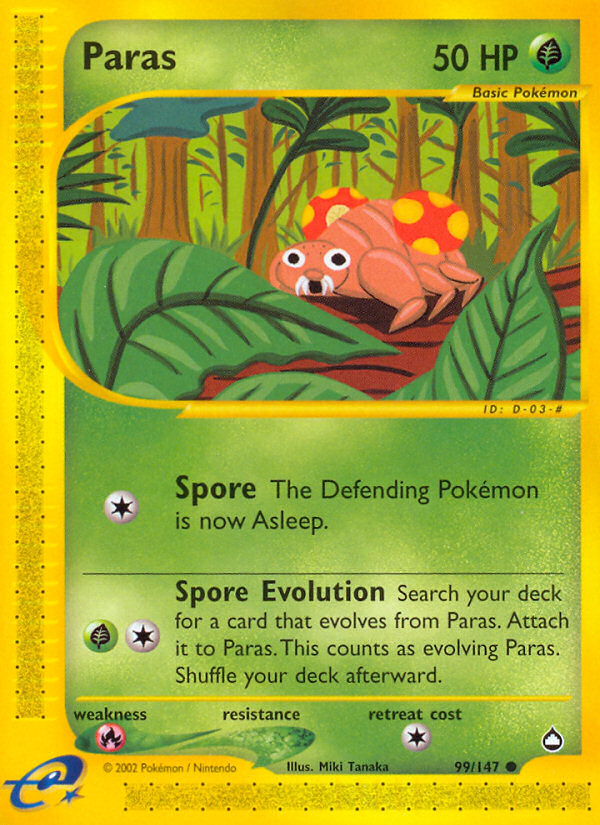
Image courtesy of TCGdex.net
Paras, Fun, and Strategy: Finding Balance in the Pokémon TCG
In the world of Pokémon TCG, not every card boils down to raw power or flashy combos. Some of the most endearing and tinkered-with strategies come from the smaller, more approachable creatures—like Paras. This Grass-type Basic from the Aquapolis era embodies a playful tension between “fun" and “competition.” Its two-pronged attack kit—Spore and Spore Evolution—offers a quirky, tempo-driven path to victory that can feel as delightful as it is nerve-wracking for an opponent who underestimates a sleepy challenge. ⚡🔥
Paras in Aquapolis: stats, flavor, and the art that fuels the vibe
- Set and rarity: Aquapolis, Common. This is a card you could pull from a core deck as a reliable early-game option rather than a chase foil, making it a favourite for nostalgic players and budget-conscious collectors alike.
- Deckhand details: Basic stage, Grass type, and 50 HP. A compact package that invites clever sequencing rather than brute force.
- Attacks:
- Spore (Colorless): The Defending Pokémon is now Asleep. A classic control move that can buy you crucial turns to set up your board.
- Spore Evolution (Grass + Colorless): Search your deck for a card that evolves from Paras. Attach it to Paras. This counts as evolving Paras. Shuffle your deck afterwards.
- Weakness: Fire ×2. That makes Paras particularly vulnerable to a persistent Fire-type offense—worth factoring into your game plan when you’re deciding how many copies of Grass energy to run or when to pace your Sleep play.
- Illustrator: Miki Tanaka. The art carries that quintessential Aquapolis charm—plants, spores, and a sense of mystery that invites both strategy and storytelling.
“A small creature with a big plan: sometimes the path to victory is not the hardest punch, but the artful pause.”
Paras’s design isn’t just about cute vibes and mushrooms. The Spore engine gives you a powerful tempo tool: you can halt your opponent’s momentum with Sleep and then pivot into a timely evolution via Spore Evolution. The synergy is a reminder that in Pokémon TCG, tempo and timing can trump raw numbers, especially when your deck is built to maximize one clean disruption turn after another. 🎴🎨
Gameplay strategies: turning a common into a clever engine
- Sleep as a tempo tool: Use Spore to place the Defending Pokémon asleep, buying you precious turns to draw into setup cards or your evolution target. In older formats like Aquapolis, sleep—paired with disciplined timing—can blunt aggressive starts and let you pivot to a late-game plan without overspending resources.
- Spore Evolution as a deck-thinning engine: The second attack turns Paras into a springboard rather than a dead-end. By searching for a card that evolves from Paras (likely Parasect), you can accelerate the transition from Basic Paras to a more threatening stage—a core idea for micro-arc strategies that rely on evolving on the same turn you threaten. Shuffle your deck after the search, which keeps your draws honest and your plan tight.
- Weakness management: With Fire-type weaknesses, you’ll want to weave in safer early-game lines when facing red-hot Fire decks. Paras doesn’t want to trade blows, it wants to stall and evolve, so pairing it with defensive or draw-support Pokémon can help you weather an early firestorm while you set up the board.
- Evolution timing and synergy: Paras evolving into Parasect (via Spore Evolution) introduces a two-stage pathway that rewards planning. If you can fetch Parasect quickly, you gain access to its evolved presence—an evergreen strategy that rewards careful deck-building around draw support and fetch effects.
Balancing fun with competition: how Paras shines for both players
Paras embodies a dual spirit that many collectors and players chase: the joy of a clever trick and the thrill of catching someone off guard. Its cute, understated silhouette and the mushroom flair in Miki Tanaka’s art are nostalgia triggers for fans who remember the early 2000s—while the mechanic itself remains surprisingly modern: a flexible, tempo-driven plan that doesn’t demand rare, expensive cards to work. This is where the heart of balancing fun and competition beats strongest: a card that invites experimentation, yet remains approachable enough to draft into casual games without needing a full tournament-ready engine. ⚡🎯
From a collector’s vantage point, Paras offers a fascinating glimpse into market dynamics. Although the non-holo Paras from Aquapolis sits in the budget tier, holo and reverse-holo variants often fetch a premium due to rarity and aesthetic appeal. Market data around this card shows a spectrum: low prices hovering around a few euros and mid-range values for non-holo copies, with reverse-holofoil copies fetching notably higher prices. This spread reflects both nostalgia-driven demand and the practical reality that holo variants hold more coveted placement in modern binders and display collections. For new collectors, Paras provides an entry point into Aquapolis-era collecting without breaking the bank. 💎
Collector insights: values, variants, and the long view
- Cardmarket pricing for non-holo Paras typically sits around a few euros on average, with holo variants climbing higher as demand and supply shift over time.
- TCGPlayer figures show similar patterns: normal (non-holo) Paras in the mid-to-low range, while reverse-holofoil versions trend significantly higher—often appealing to nostalgia-driven buyers and set-builders aiming to complete Aquapolis runs.
- Durable appeal comes from Paras’s role as a stepping-stone to Parasect. The possibility of evolving Paras during the Spore Evolution attack makes this card a fun puzzle piece for deck builders who love chaining evolution tempo in a single turn.
- Beyond price, the artwork—courtesy of Miki Tanaka—adds collectible value for fans who appreciate the era’s distinctive visual style and the thematic tie-ins with Paras’s mushroom ecosystem.
What this means for players and fans today
Even amid modern shifts in the Pokémon TCG meta, Paras remains a symbol of how strategy can emerge from simplicity. Its two-pronged toolkit—sleep disruption and a deck-search evolution path—offers a blueprint for players who relish clever sequencing over brute force. For collectors, Paras is a gentle reminder of the Aquapolis era’s distinctive charm and the way price signals can reflect both nostalgia and playability. And for fans who simply love the Pokémon universe, Paras’s lore-friendly design and Miki Tanaka’s art make it a lovable centerpiece in any binder.
As you curate your own Paras-focused build, consider pairing it with supportive draw and search effects that help you reliably reach Spore Evolution when you need it most. The goal is to blend the whimsy of a sleeping Defending Pokémon with the cunning of a timely evolution—and then savor the moment when your opponent realizes they’ve underestimated the little mushroom Pokémon that could. 🎮💎
Ready to level up your desk decor and your deck? Check out the Neon Phone Stand for Smartphones — Two-Piece Desk Decor & Travel to complement your gaming space, and pick up Paras in a way that honors both fun and competition.
Neon Phone Stand for Smartphones — Two-Piece Desk Decor & Travel
More from our network
- https://blog.digital-vault.xyz/blog/post/martyrdom-card-art-artist-commentary-and-production-techniques/
- https://crypto-acolytes.xyz/blog/post/blue-scutum-star-illuminates-spectral-class-from-teff/
- https://blog.zero-static.xyz/blog/post/chimney-goyf-reimagined-fan-art-tributes/
- https://crypto-acolytes.xyz/blog/post/minecraft-dungeon-mods-top-picks-to-elevate-your-run/
- https://transparent-paper.shop/blog/post/designing-notion-dashboards-for-entrepreneurs-to-scale/