
Image courtesy of TCGdex.net
Small Package, Big Edge: Skitty’s Role in Early-Game Strategy
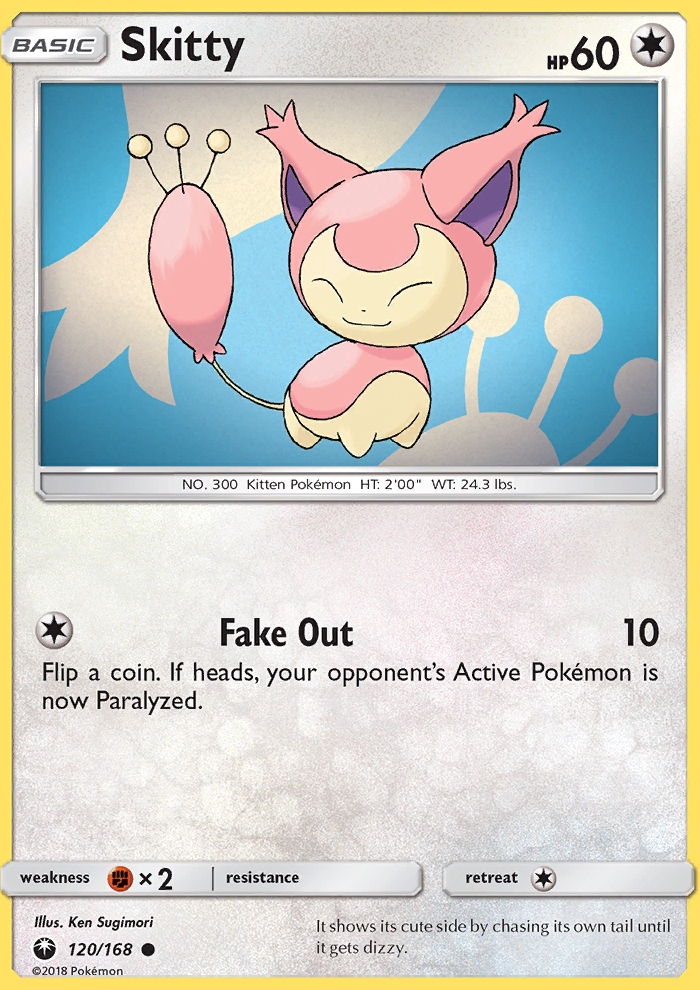
In the whirlwind world of the Pokémon TCG, sometimes the smallest engine drives the fastest wins. Skitty, a basic Colorless Pokémon from the Celestial Storm set illustrated by the legendary Ken Sugimori, embodies that truth. With a modest 60 HP and an unassuming one-energy attack, Skitty invites players to think beyond raw power and toward tempo, disruption, and tempo-swinging turns. When built with care, this little cat can menace opponents in the opening rounds, buying you precious turns to set up Delcatty and friends who will carry the game later on. ⚡🔥
Card snapshot: what you’re really playing with
- Name: Skitty
- Set: Celestial Storm
- Rarity: Common
- HP: 60
- Type: Colorless
- Stage: Basic
- Attack: Fake Out — Cost: Colorless. Effect: Flip a coin. If heads, your opponent’s Active Pokémon is now Paralyzed. Damage: 10
- Weakness: Fighting ×2
- Retreat: 1
- Illustrator: Ken Sugimori
- Evolution: Evolves into Delcatty
- Legal formats: Expanded (Standard: not legal)
With its simple tool kit, Skitty invites a flexible approach. The “Fake Out” attack is not about massive damage; it’s about leverage. On your opponent’s turn, paralyzing the active Pokémon can buy you a full turn of control, forcing them to adapt rather than press with a direct threat. In Celestial Storm’s ever-shifting meta, that kind of disruption—especially early—can snowball into a sizable tempo swing. And because Skitty is a basic Pokémon, you can place it on the bench early and keep it ready to evolve when the moment is right, turning a small investment into a mid-game anchor as Delcatty begins to draw more cards and accelerate your options. 🎴🎨
Early-game tactics: weaving disruption into tempo
Strategy starts with the mindset that you’re not just trying to hit for small damage; you’re trying to seize the initiative. On the first turn you can attach energy to Skitty and set up a threatening board, but the real tempo comes when you go second and flip that coin with Fake Out. If you land heads, your opponent’s Active is Paralyzed, which often means they either have to retreat or pass through a turn of vulnerability. In a crowded Expanded format, that extra turn of safety can be the difference between pressuring a setup opponent and letting them gather the resources you’ll need to break through on turn three or four. And since Skitty naturally evolves into Delcatty, you’re also laying the groundwork for a mid-game engine that can draw aggressively and pressure your opponent’s defenses. 💎
Think of Skitty as the “opening gambit” piece in a broader tempo plan. Pair it with cards that help you keep a healthy bench and protect your board state, and you can force your opponent into uncomfortable decisions: retreat costs, coin-flip variance, or riskier plays to answer your disruption. Because the attack costs Colorless, you’re not locked into a specific energy type, so Skitty slots neatly into many decks—whether you’re leaning into a pure draw-based engine or a hybrid that leans on early pressure. The allure is not raw damage but the pressure and unpredictability you generate in the opening turns. ⚡🎮
Deck-building notes: Delcatty and beyond
One of the strongest reasons to value Skitty is its potential to evolve into Delcatty, a step that unlocks greater deck consistency and draw power in many Celestial Storm-inspired lines. A typical Delcatty-supporting shell seeks to maximize card advantage while maintaining enough reach to push through early-paralyze scenarios. Skitty acts as the spark that starts the engine: you use Fake Out to stall, potemically forcing a decision from your opponent, and then you accelerate by evolving to Delcatty and drawing into your next key pieces—whether that’s additional Energy, supporters, or another attacker. The synergy is practical, not flashy, but in the long game it often wins more games than raw power alone. 🎴💎
From a value perspective, Skitty sits in the budget-friendly lane for many players. Non-holo copies tend to hover around modest averages, with holo variants commanding a modest premium. CardMarket shows averages around €0.10 for standard copies, with holo versions nudging higher; TCGPlayer data echoes this, with low prices near a few cents and midrange prices for popular variants in the low tens of cents or under a dollar for common versions. For collectors, that accessibility makes Skitty a fun addition to a modern or retro deck without a prohibitive cost barrier. This is the kind of card that shines in play and in collection, especially for players who love breathing new life into old archetypes. 🔥
Market and collecting notes
Celestial Storm remains a beloved set for many players because of its familiar feel and the way it blends classic Pokémon vibes with contemporary gameplay. Skitty’s art by Ken Sugimori resonates with fans who grew up with the franchise, and that nostalgic pull often translates into steady interest in the card, particularly in holo or reverse-holo forms. Even as the Expanded format welcomes more modern staples, a well-timed Fake Out can still create memorable moments in casual and league play, making Skitty a small but persistent favorite among budget-conscious players who value playability and flair. 🎨
Phone Grip Kickstand Reusable Adhesive HolderMore from our network
- https://crypto-acolytes.xyz/blog/post/three-simple-steps-to-a-portfolio-website-and-six-pro-tips/
- https://blog.digital-vault.xyz/blog/post/data-coverage-under-scanning-law-reveals-color-discordance-at-246-kpc/
- https://blog.digital-vault.xyz/blog/post/zealous-guardian-white-origins-lore-and-set-context/
- https://crypto-acolytes.xyz/blog/post/starbase-hires-cameron-county-to-police-streets-and-jail-offenders/
- https://transparent-paper.shop/blog/post/precision-photometry-and-brightness-curves-unveil-crux-blue-giant/