
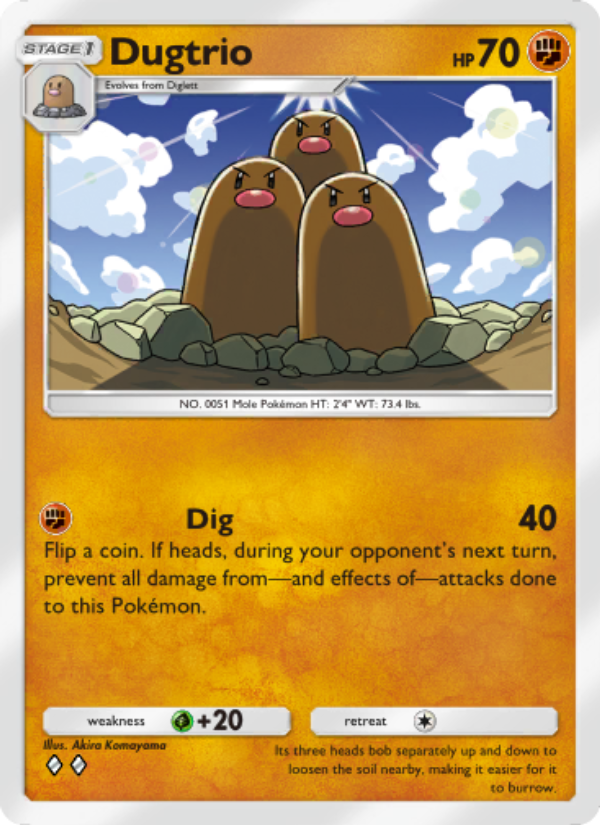
Image courtesy of TCGdex.net
Balancing Evolution Chains: A Dugtrio Case Study in the Pokémon TCG
⚡ In the world of Pokémon TCG, the tiny choices in an evolution line can tilt the entire match—especially when a Stage 1 card like Dugtrio steps into the chaos with a clever defensive tool tucked into its moveset. 🔥
When we talk about evolution chains, the spotlight often falls on the bigger evolutions and the flashy attackers. Yet the DNA of a healthy TCG ecosystem sits in the quiet moments: how a single evolution, such as Dugtrio from Genetic Apex (A1), balances risk, timing, and board presence. This Dugtrio, illustrated by Akira Komayama, is a Stage 1 Fighting-type with 70 HP, evolving from Diglett, and featuring a signature attack that hinges on a coin flip. Its rarity—Two Diamond—speaks to a careful design choice: it’s powerful enough to feel meaningful, but not so dominant that it erases the value of the rest of the chain. The card’s evolution chain is a microcosm of how a well-balanced line should feel in practice: compelling to draw, entertaining to play, and fair across a spectrum of matchups.
What makes this Dugtrio tick?
- Evolution and stage: Dugtrio evolves from Diglett, placing it squarely in the early-to-mid game window where players are building towards a mid-game swing. Its Stage 1 status discourages late-stage dominance but keeps it relevant for tempo-based decks that want to pressure the board while setting up a longer plan.
- HP and stats: With 70 HP, Dugtrio sits in a zone that rewards careful play. It’s not a brick-wall, but it can endure exchanges long enough for its control element to matter—especially when the field is thin or when you’re protecting a bench setup.
- Attack and utility: The Dig attack costs Fighting energy and deals 40 damage, a respectable figure for a Stage 1. But its real trick is the coin-flip effect: “If heads, during your opponent’s next turn, prevent all damage from—and effects of—attacks done to this Pokémon.” That conditional shield invites clever timing—you’re aiming to weather the next big hit while you advance a plan, or buy a crucial turn to retreat safely, set up a stronger threat, or stall while your bench evolves toward a bigger payoff.
- Weakness and retreat: A Grass weakness (+20) adds strategic texture, nudging players to consider type matchups and deck construction around spread damage and protection. A Retreat Cost of 1 keeps it nimble enough to reposition without overcommitting resources.
- Art and flavor: Akira Komayama’s depiction brings the triple-headed digger to life, with a flavor text that evokes its soil-sculpting lore: “Its three heads bob separately up and down to loosen the soil nearby, making it easier for it to burrow.” Flavor and function align, a hallmark of well-balanced cards.
In practice, this Dugtrio encourages decks to think in terms of tempo and resilience. You’re not just pressing damage onto a single wall; you’re shaping a dynamic where your opponent must respect the threat while you leverage your coin-flip protection to weather the storm. If your opponent’s strategy hinges on burst damage or a relentless onslaught, Dugtrio’s defensive window can be a lifeline. If they pivot to a more controlled playstyle, you’re setting up a grounded, mid-game plan that capitalizes on gradual damage and board control.
Balancing considerations for evolution lines
From a game-design perspective, a Stage 1 like Dugtrio tests the balancing boundaries of a line. It sits between Basic attackers and more advanced evolutions, offering a tactical tool without guaranteeing a game’s outcome. The fact that this Dugtrio is from a print with the set name Genetic Apex (A1) and a total card count of 286 is a reminder that collectible ecosystems thrive on both novelty and a sense of continuity within an evolving meta. The holo, reverse, and normal variants present collectible avenues that keep players invested—while the card’s non-legal status in standard and expanded play at the time of writing signals the ongoing balancing work that packs and designers engage in to preserve a healthy rotation and diverse deck-building space.
For players eyeing the long game, evolving from Diglett into this Dugtrio is a lesson in pacing. It’s not about stalling for stall’s sake; it’s about thoughtful tempo, knowing when to press a small advantage and when to retreat to safety, and recognizing that a single coin flip can tilt the odds in a tough matchup. In formats with evolving rules and rotating sets, this kind of utility-based guard rail—where a card can dampen an opponent’s momentum for a critical turn—remains a valuable design principle.
Collector insights: rarity, variants, and value conversations
Collectors approach a card like this Dugtrio with considerations beyond raw power. The “Two Diamond” rarity signals a tier that’s accessible but still aspirational for many players. The existence of multiple variants—normal, holo, and reverse holo—adds layers of value and display appeal. For investors and collectors, the holo version often carries a premium due to rarity and aesthetic appeal, while the reverse holo can be a gateway to broadening a collection without overspending on the most scarce prints. The Genetic Apex branding, with its official card count and set symbol, helps anchor the card within a broader storytelling arc—an angle many collectors appreciate when tracing lineages through the game’s evolving history.
Market dynamics around any given Dugtrio print are influenced by playability, nostalgia, and the overall health of the Genus Apex subset. Even when a card isn’t currently legal in standard or expanded play, it can remain highly collectible for fans who relish the lore, artwork, and the idea of a “what-if” deck built around a well-balanced evolution chain. The balance between play value and collectibility is a dance that keeps both casual fans and dedicated collectors engaged ⚡💎.
Practical deck-building tips for this Dugtrio
- Tempo play: Use Dugtrio to blunt aggressive starts. Its Dig attack gives you a safety net that buys a turn or two to set up your bench and prepare a stronger mid-game pivot.
- Deck arc: Pair it with a Diglett line that can accelerate evolution or protect your bench with supportive tools. The goal is to maximize the value of the coin-flip shield without over-reliance on luck.
- Type matchups: Beware Grass weaknesses. Build your energy and retreat plans to avoid being overwhelmed by quick Grass-type finishes, or complement with defensive Pokémon that resist or soak Grass hits.
- Variant awareness: If you’re chasing holo or reverse holo variants, factor in the increased rarity and display potential when budgeting for collection goals.
- Play environment: In formats where this Dugtrio is legal, its timing shines in stall- or control-oriented archetypes. In rotation-heavy metas, leverage its resilience during transitional turns rather than expecting it to win outright.
For players who love the thrill of evolving lines, Dugtrio’s place in Genetic Apex offers a compact, thoughtful archetype: a transitional powerhouse that rewards timing, carefully allocated energy, and smart matchups. It’s a reminder that the health of a TCG ecosystem rests on how well a simple three-headed digger can coexist with its broader family, while still delivering memorable moments in both gameplay and collectibility 🔥🎴.
Curious about the practicalities of picking up this card or exploring the Genetic Apex set further? Check out the product page for related gear and accessories that pair well with a collector’s journey—the rugged, glossy finish of the case mirrors the polished look of holo and reverse holo prints you might chase in your Dugtrio runs. And if you’re hungry for more reading on evolving strategy, dive into the linked articles below for a broader perspective on roadmaps, photometry, drafts, and beta testing in the world of collectibles and gaming ecosystems. 🎨🎮
Rugged Phone Case — Impact Resistant Glossy FinishMore from our network
- https://transparent-paper.shop/blog/post/creating-feedback-driven-roadmaps-that-drive-strategy/
- https://blog.digital-vault.xyz/blog/post/precision-photometry-reveals-brightness-curve-of-a-35k-k-hot-giant/
- https://blog.zero-static.xyz/blog/post/draft-strategy-insights-changeling-outcast-in-limited/
- https://blog.rusty-articles.xyz/blog/post/vodalian-soldiers-borderless-evolution-and-showcase-variants/
- https://transparent-paper.shop/blog/post/leveraging-beta-testing-with-early-adopters-for-product-validation/